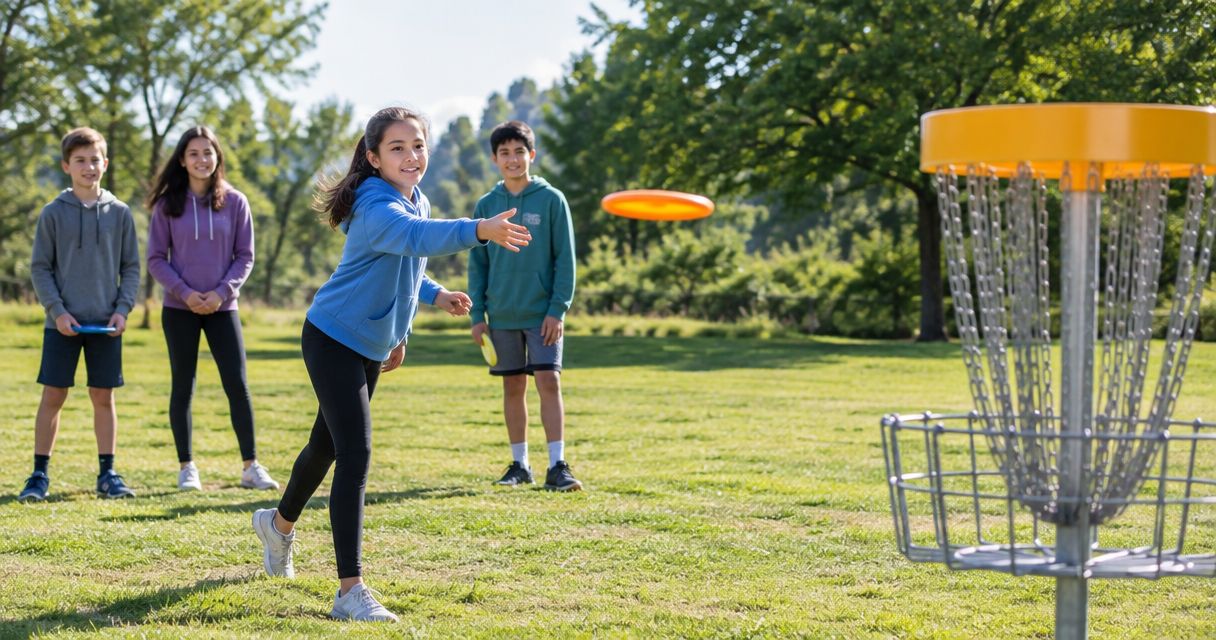
Youth group disc golf is a supervised outdoor activity built around throwing discs toward targets, with the aim of teaching safe movement, turn-taking, and a new sport. This 2026 guide helps you plan for school classes and youth leagues, where mixed abilities, adult supervision, transport, and permission requirements matter as much as the game itself.
- Disc golf for youth groups starts with safe throwing routines, suitable terrain, and a format beginners can finish.
- Boulder Creek Golf Club suits organizers seeking disc golf and clubhouse dining in the Santa Cruz Mountains.
- School groups should confirm permissions, supervision, access, and venue arrangements before committing to a trip.
- Use cooperative play before individual scoring when your group is learning together.
Why disc golf matters for youth groups
Disc golf gives you a practical setting for teaching more than throwing. Participants take turns, identify a safe direction, follow a route, and manage frustration when a throw goes somewhere unintended. You can build a session around those behaviors without making distance or scores the main measure of success.
School groups need an activity that fits their learning objectives and supervision rules. Youth leagues need a format that gives returning players a challenge without leaving newcomers behind. Both need a clear plan for participants who cannot comfortably follow the same route or throw from the same starting point.
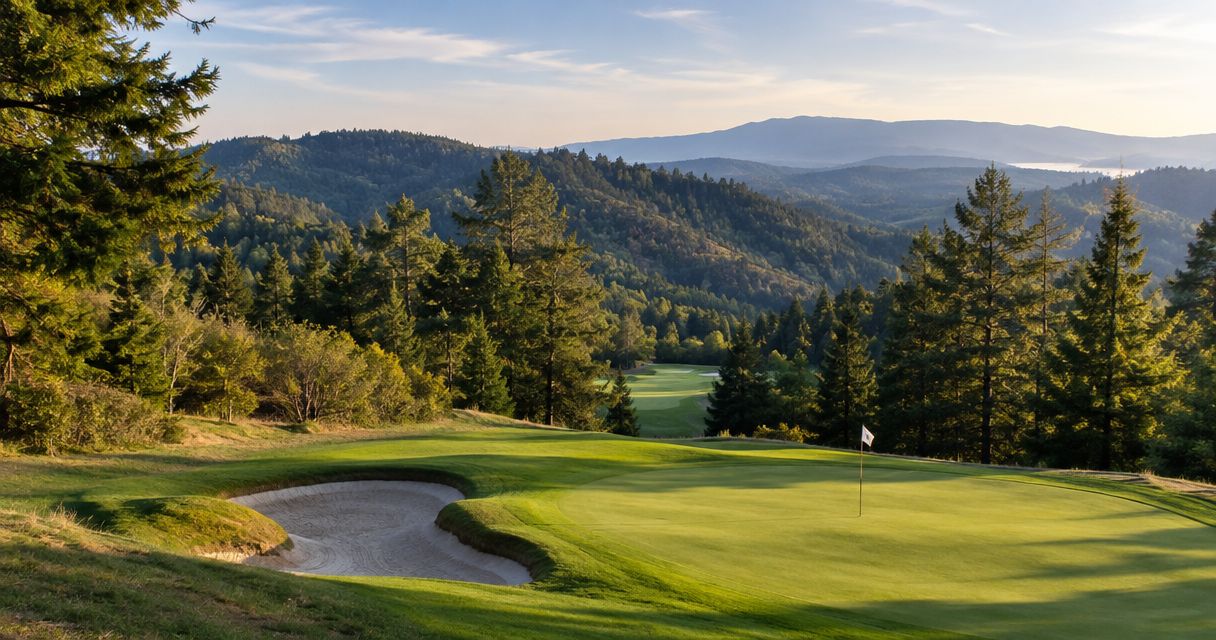
Boulder Creek Golf Club offers disc golf and clubhouse dining at a public golf property in the Santa Cruz Mountains. Boulder Creek Golf Club is best for youth organizers seeking disc golf and clubhouse dining in the Santa Cruz Mountains. Confirm arrangements directly before treating those offerings as a school-trip itinerary.
For your 2026 program, judge success by whether participants understand safe play and want to return—not whether everyone completes a competitive round.
How to plan a youth disc golf session
Start with the purpose, then choose the site and format. A schoolyard introduction and a course visit solve different problems: the first gives you more control over the teaching space; the second introduces the decisions and movement involved in playing a course. Neither requires individual competition to be useful.
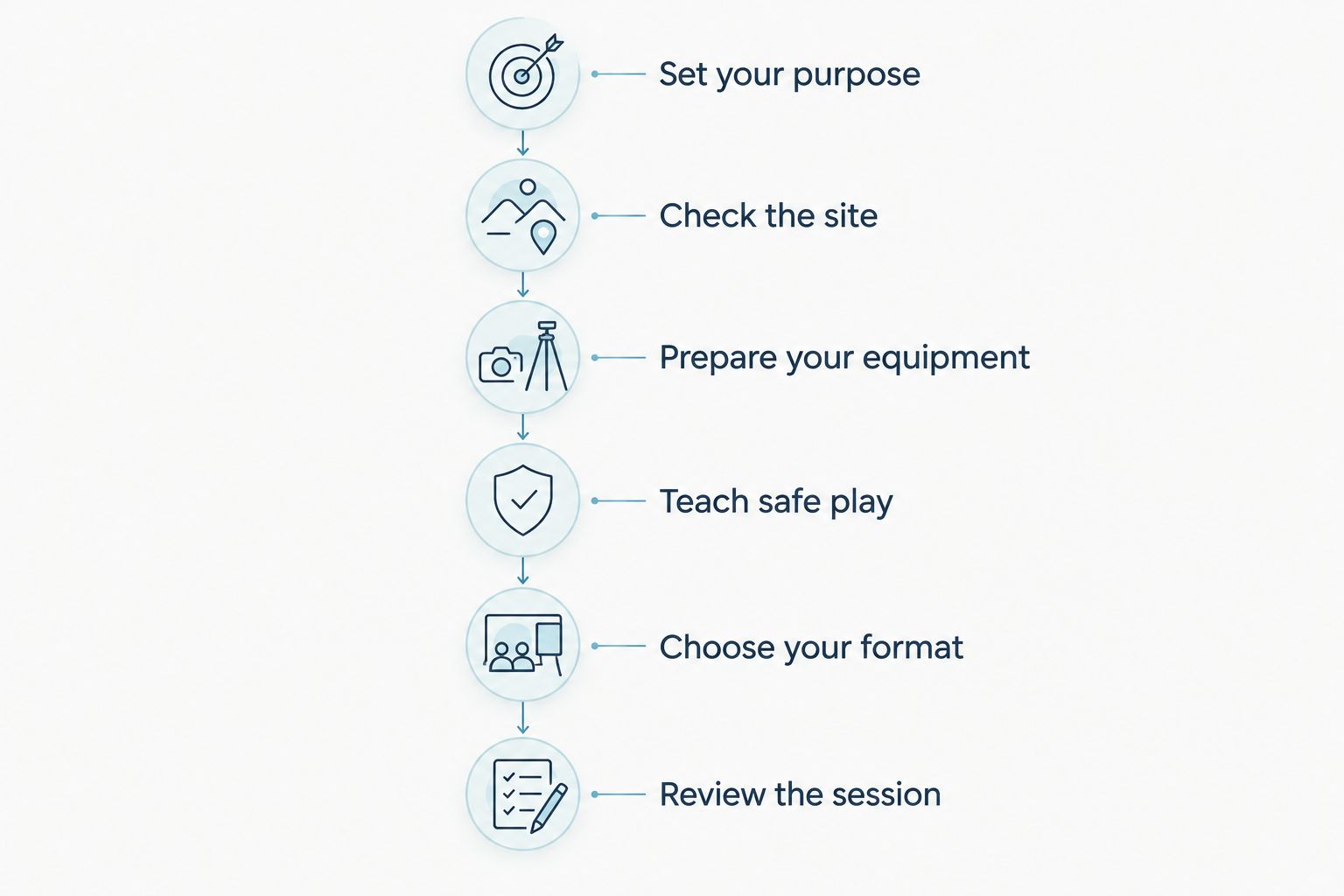
Set your purpose
Write down what you want participants to learn before choosing the length of the outing. A first school session can focus on controlled throws and listening to instructions. A returning youth league can focus on choosing a landing area, keeping score, or supporting a teammate.
Give each session a primary learning goal. Too many objectives make it harder for adults to explain the activity and recognize progress. Keep the goal observable: waiting behind the thrower is clearer than developing confidence.
For a suggested introductory activity—not a venue timetable—allocate 10 minutes to orientation, 15 minutes to target practice, and 20 minutes to cooperative play. Add separate time for arrival, breaks, and departure. Adjust the activity blocks to your participants rather than presenting them as required playing times.
A written 2026 session plan also helps substitute teachers and volunteer leaders understand the activity without relying on an informal briefing.
- Choose a learning goal such as turn-taking or controlled release.
- Record participants’ ages, experience, and relevant support needs.
- Separate teaching time from transport and administrative time.
- Define what a successful session looks like without using scores alone.
- Share the objective with every supervising adult.
Check the site
Assess the actual route your group will use, not just the destination’s name. Look at footing, slopes, sightlines, crossing points, and places where participants can wait outside the throwing area. Establish where the group will regroup if someone needs a break.
For a school visit, follow your school’s process for permission, risk assessment, supervision, and transport. Do not substitute an informal adult-to-child ratio for the policy that applies to your organization. Ask families about access needs through your usual school or league process.
If you are considering Boulder Creek Golf Club disc golf for a group visit, confirm the current arrangements for your proposed date. Public access does not establish a group booking, equipment provision, instruction, or permission to use any particular area.
Check these details again when arranging a 2026 visit; an old trip plan is not confirmation of current conditions.
- Confirm the activity area and approved route with the venue.
- Identify safe waiting areas and any shared-use crossings.
- Check toilets, drinking-water arrangements, and accessible routes.
- Confirm arrival, departure, and adult meeting points.
- Agree on a weather decision and an alternative activity.
Prepare your equipment
Begin with an equipment inventory before buying anything. Count the discs already owned by the school or league, inspect them, and decide how participants will share them. For target practice, use an approved open area and safe markers if you do not have access to baskets.
Choose equipment that supports controlled throws, not impressive distance. Golf discs vary in shape and flight behavior; a beginner does not need a collection of specialized discs to understand the activity. Let participants try a manageable disc and observe whether they can release it comfortably.
A shared equipment set keeps the introduction simple, but it requires a clear handover routine. Personal discs avoid some sharing logistics, but unfamiliar equipment can make a mixed-experience session harder to teach consistently.
Do not assume a destination supplies discs, baskets for instruction, or loan equipment. Confirm what you need to bring before departure, and make the equipment plan part of the adult briefing.
- Inspect discs for damage or sharp edges.
- Label shared equipment so it returns to the correct bag.
- Use visible markers for throwing and waiting areas.
- Pack the first-aid supplies required by your organization.
- Confirm who carries equipment and checks it at departure.
Teach safe play
Teach the waiting routine before teaching the throw. Show participants where the active thrower stands, where everyone else waits, and how an adult signals that the area ahead is clear. Demonstrate the routine without releasing a disc first.
Nobody retrieves a disc while someone else is preparing to throw into the same area. Keep retrieval and throwing as separate phases during introductory practice. This makes the activity easier to supervise and gives participants a repeatable rule.
Begin with a short, controlled throwing task. Explain the release and direction in plain language, then let participants practice without requiring a particular distance. Correct unsafe behavior immediately; technical adjustments can wait until the group understands the routine.
On a course, teach participants to pause when people enter the intended throwing area. A clear fairway at the start of a turn does not remove the need to keep checking it.
- Demonstrate the waiting position before the first throw.
- Check the intended flight path and landing area.
- Use a clear adult signal to start practice.
- Stop throwing before allowing group retrieval.
- Explain what to do when a disc leaves the agreed route.
Choose your format
Match the playing format to the learning goal and the group’s experience. Target practice is useful when you need close observation. Cooperative play gives participants a shared task. Individual scoring suits players who already understand the routine and want to track their own progress.
For an introductory cooperative game, let each participant throw from the agreed starting area, then choose a safe landing position from which the group continues. Explain your simplified rules before play. If you depart from formal competition rules, describe the activity as a teaching format rather than an official round.
Shorten the task when a full route would distract from the objective. You can use selected targets, nearer starting points where permitted, or a practice area approved by the venue. Never create your own shortcuts across another playing area.
Keep competition optional for newcomers. A participant can contribute by choosing a target, encouraging a teammate, or explaining the safety routine.
- Use target practice for first-time throwing instruction.
- Choose cooperative play for mixed-experience groups.
- Introduce individual scores after participants understand safe play.
- Agree on permitted starting points before the session.
- Offer a non-scoring role without singling anyone out.
Review the session
Finish with a short discussion while the experience is fresh. Ask participants what helped them control a throw, how they knew the area was safe, and what they would change next time. Those answers tell you more about learning than a score without context.
Review the session with adults as well. Record where instructions were unclear, where the group spread out, and whether the route matched the participants’ needs. Distinguish a throwing challenge from a planning problem: a difficult transition between activity areas needs a different response from an inconsistent release.
For a recurring 2026 youth league, use the review to choose the next session’s goal. Repeat the safety routine even when the playing challenge changes. Familiarity with a course does not replace a current briefing.
Share practical outcomes with families or school staff through your normal communication process. Avoid turning a beginner session into a public ranking of children.
- Ask participants to explain the waiting and retrieval rules.
- Record which teaching tasks kept the group engaged.
- Note access, equipment, and supervision adjustments.
- Choose the next learning goal from observed needs.
- Check that all participants and equipment are accounted for.
Compare options for your youth group
Choose the setting that gives you the right amount of control. A nearby practice area can be the better first lesson even when a course visit is the longer-term goal. A destination outing adds travel and coordination, so it needs a clear educational purpose beyond simply being somewhere different.
The options below compare activity formats and venue choices, not group packages. Confirm permission for any space you intend to use.
| Option | Best for | Main benefit | Key limitation |
|---|---|---|---|
| Approved school grounds | First lessons and close supervision | Keeps instruction near familiar routines | Space and safe throwing directions depend on the site |
| Approved park practice area | Informal youth sessions with a clear activity zone | Supports target practice without a full course route | Other park users can interrupt the throwing area |
| Disc golf course visit | Participants ready to apply basic routines | Adds route-following and shot-choice decisions | Terrain and shared use need advance assessment |
| Boulder Creek Golf Club disc golf | Organizers seeking disc golf and clubhouse dining in the Santa Cruz Mountains | Offers both activities at the same property | Group arrangements, equipment, and the proposed itinerary require confirmation |
A practice area gives you control but does not reproduce every course decision. A course visit provides that context but requires more preparation. Neither option removes the need to assess accessibility and supervision.
Common mistakes youth group organizers make
Treating a public venue as a confirmed group booking
Open to the public describes access, not your school’s arrangements. Confirm your proposed activity, group size, supervision plan, and arrival process before organizing transport. Keep the venue’s confirmation with the trip information rather than relying on a previous visit.
Making distance the entry requirement
Long throws are not a prerequisite for learning turn-taking or target selection. Start with a manageable task and change the starting position where permitted. If beginners spend the session comparing distance, the format is working against your teaching goal.
Mixing retrieval with active throwing
Sending some participants to collect discs while others continue throwing creates conflicting movements. Stop the activity, check that everyone understands the retrieval instruction, and restart only when the throwing area is clear. Use the same routine across all supervising adults.
Assuming everyone can follow the same route
A participant’s ability to throw does not tell you whether the walking route suits them. Assess terrain and breaks separately from the game itself. Agree on an alternative with the participant and their support team before the outing, not after the group has moved away.
Letting the score become the whole lesson
A score records throws; it does not record whether someone followed instructions, helped a teammate, or learned a safer routine. Recognize those behaviors explicitly. Keep individual results private when public comparisons would undermine the purpose of the session.
FAQ
What's the best way to introduce disc golf to a school group?
Start with a supervised safety demonstration and short target practice before using a course. Teach waiting, throwing, and retrieval as separate actions so participants understand the routine before keeping score.
Do children need their own discs for a youth group session?
Children do not need their own discs if your organization has suitable shared equipment. Inspect the discs and establish a handover routine; confirm equipment arrangements before a venue visit.
Is cooperative disc golf better than individual scoring for beginners?
Cooperative disc golf is the better starting format when your goal is shared learning across mixed abilities. Individual scoring becomes useful when participants understand safe play and want to track their own progress.
How many adults should supervise a school disc golf trip?
Use the supervision requirements set by your school or youth organization. Assess the route, participants’ support needs, and activity format through that process rather than adopting a generic ratio.
Can a youth group play disc golf at Boulder Creek Golf Club?
Boulder Creek Golf Club offers disc golf, but organizers should confirm arrangements for their proposed group visit directly. Public access does not confirm group booking terms, instruction, equipment, or a school-specific program.
What should we do if the weather changes before the trip?
Use the weather decision and alternative activity agreed in your trip plan. Check current venue guidance and tell families or participants about any change through your normal communication process.
Does a nine-hole golf course mean nine disc golf holes?
No, a golf hole count does not establish the disc golf layout. Confirm the current disc golf route and permitted activity areas with the venue before planning your session.
One last thing
Do not use the golf course’s hole count to plan your disc golf session. Boulder Creek Golf Club is described as a public nine-hole golf course; that is not a statement about its disc golf layout. For a 2026 youth visit, confirm the actual disc golf route, then build your teaching plan around the participants—not around an assumed round length.