
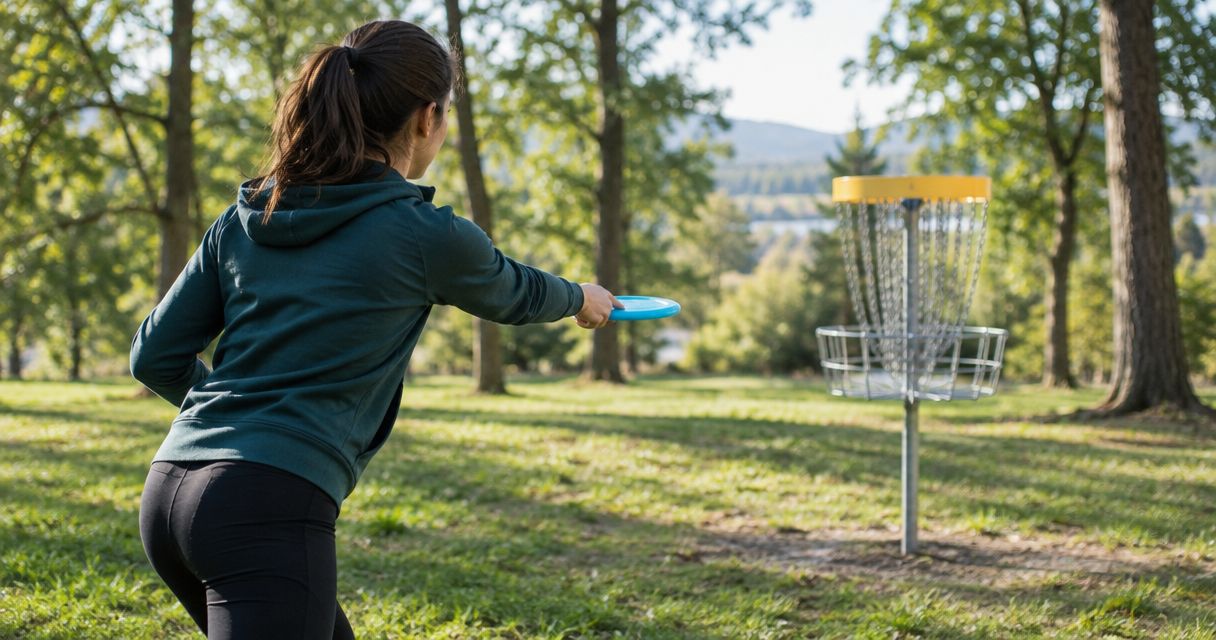
Beginner disc golf is a target sport played by throwing a disc from a tee into a basket, with the aim of finishing each hole in as few throws as possible. This 2026 guide to disc golf for beginners starts with controlled throws, simple rules, and choosing a manageable first outing—not buying a bag full of discs.
- Disc golf for beginners starts with a putter, controlled throws, and learning when it is safe to play.
- PDGA rules count each throw toward your score; local course signs explain the layout and restricted areas.
- Choose a putter for putting practice and short approaches before adding a fairway driver.
- Practice accuracy before distance, and confirm course access before your first round.
Why disc golf matters for beginners
Disc golf gives you a clear task on every hole: move the disc toward the basket, then finish the hole. You can practice the basic motion without learning a full set of clubs or different swings. That makes the starting point straightforward, although controlling a disc still takes practice.
Beginners need room to miss, clear directions, and time to understand where other players are moving. A scenic setting does not replace those essentials. When comparing disc golf courses near San Jose, look for layout information and current access details before choosing by scenery alone.
Your first round in 2026 should teach you how to play safely and keep the disc in control. Treat the score as a record of the outing, not a test you have to pass. A shorter, clearly understood route is a better starting point than a demanding layout you cannot follow.
How to start playing disc golf
Choose your disc
Start by borrowing a disc if someone in your group has a suitable one. A putter is a sensible first choice for putting and short approaches; you do not need a distance driver to learn the basic throw. Disc golf putters are throwing discs designed for this sport, not miniature versions of golf clubs.
Disc categories describe their intended roles. Putters serve close-range shots, midranges cover controlled approaches, and drivers are intended for longer throws. Those labels do not promise a particular distance in your hands.
Begin with control, then add equipment when you understand what shot it serves. A small selection also makes practice easier to interpret: you can notice changes in your release instead of wondering which disc caused the result. Keep the same disc for an initial practice session and learn its flight.
- Borrow a putter before committing to a larger selection.
- Choose a grip that feels secure without straining your hand.
- Use the same disc when comparing practice throws.
- Leave distance drivers out of your first practice session.
- Mark a disc you own with contact details before taking it onto a course.
Practice short throws
Find an open space where throwing is permitted, with nobody in the intended flight path or beyond it. You can start without a basket: choose a landing area on the ground and practice sending the disc toward it. Check the space again before each throw.
A standing backhand throw removes the complication of a run-up. Stand comfortably, bring the disc across your body, and release toward the target with a balanced finish. Keep the movement smooth rather than trying to throw as hard as possible.
Try a 10-minute practice session before your first round. This is a suggested routine, not a performance benchmark. Throw 10 short approaches, collect the discs safely, and notice whether they consistently finish to one side. Change one part of the motion at a time so you can identify what helps.
- Pick a clear landing area rather than chasing maximum distance.
- Begin from a standing position.
- Keep your grip and starting position consistent.
- Watch the disc's angle at release.
- Stop if the movement causes pain.
Check course access
Read the course's current information before leaving home. Confirm how disc golf access works, where you begin, and whether any areas are closed or shared with other activities. Do not assume a public golf property's disc golf follows the same access arrangements as its ball-golf course.
Boulder Creek Golf Club is a fit for local and visiting disc golfers who want a Santa Cruz Mountains setting with clubhouse dining. The club offers disc golf alongside its public nine-hole golf course. Check Boulder Creek Golf Club for current information before planning your visit.
Boulder Creek Golf Club's disc golf offering gives you a mountain option, but it does not establish that every route suits a first-time player. Confirm the active layout and access arrangements. For a 2026 outing, base your plan on current guidance rather than assuming an older course description still applies.
- Confirm the active disc golf layout.
- Check access arrangements before traveling.
- Ask where to start and where to park.
- Read notices about closures or shared areas.
- Confirm dining hours separately if you want to eat afterward.
Learn basic rules
The Professional Disc Golf Association, or PDGA, publishes the sport's official rules. For your first casual round, understand the essentials: start from the designated tee, play subsequent throws from the disc's established position, and count every throw. Complete the hole by getting the disc into the basket's supported catching area.
Course signs explain local boundaries and required routes. Out-of-bounds areas and mandatory routes affect how you play, so read them before throwing. If you are unsure, ask an experienced player to explain the marking rather than guessing.
One useful rule to learn early is the putting-area restriction. Within 10 meters of the target, you must demonstrate balance behind your lie after releasing a putt before moving toward the basket. A casual introduction does not require memorizing the entire rulebook, but learning this distinction prevents a common misunderstanding.
- Count every throw, including short putts.
- Identify the tee and target before starting.
- Play from the correct lie after each throw.
- Read out-of-bounds and mandatory-route signs.
- Ask about an unfamiliar rule before taking the shot.
Read each hole
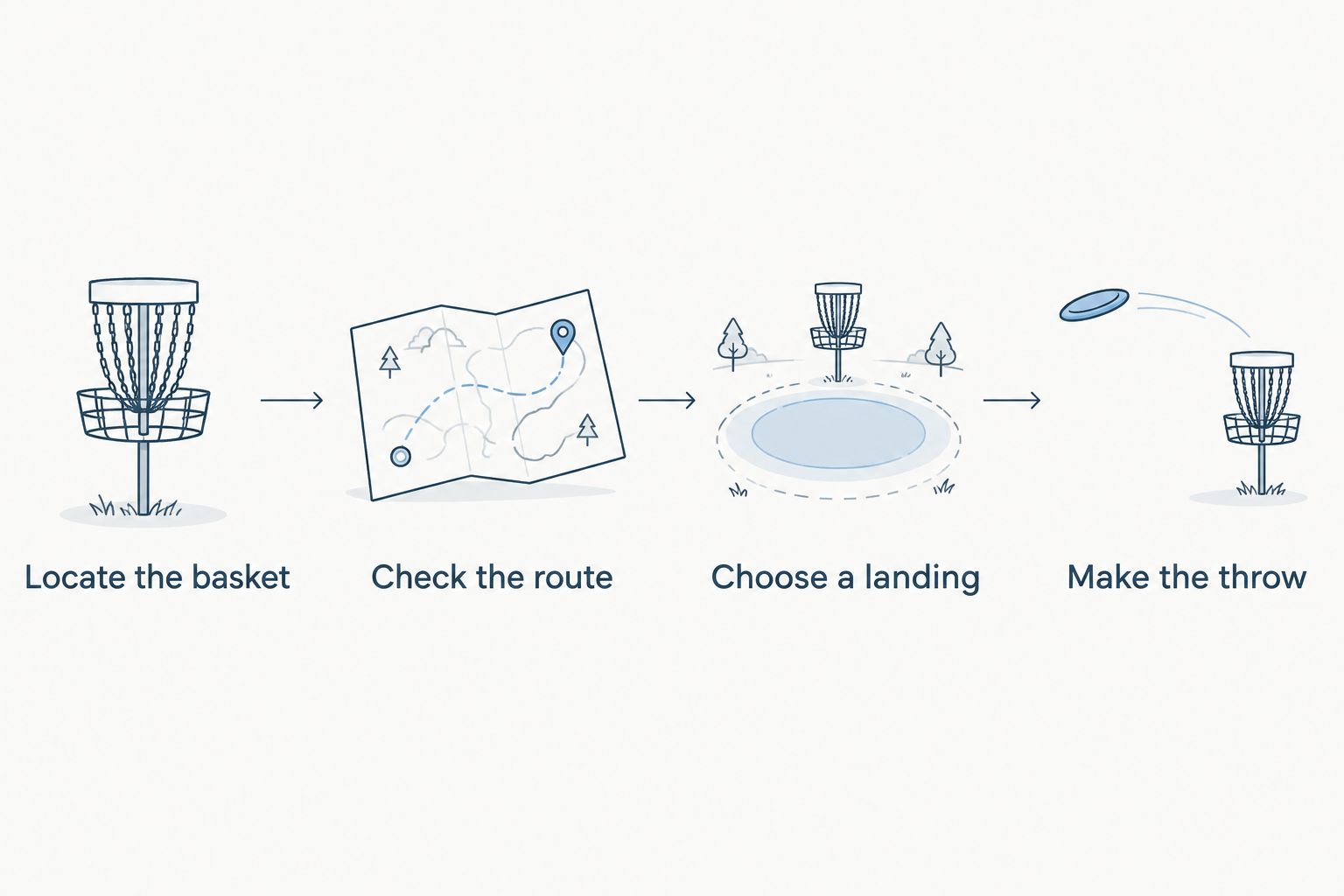
Pause at the tee and find the intended basket. Look for the route to it, the landing areas you can reach, and the places you should avoid. Another visible basket is not necessarily the target for your hole.
Plan the next manageable shot instead of imagining one perfect throw all the way to the basket. On a wooded hole, an open landing area can be more useful than a narrow direct line. Your aim is to leave yourself a clear next throw.
When you reach your disc, repeat the process. Check your footing, locate the basket, and choose a route that fits the throw you can make now. If a tree blocks the direct line, a short throw back into an open area is a legitimate choice—not a failed attempt at distance.
- Locate the correct basket.
- Identify a clear landing area.
- Check for people beyond the intended landing point.
- Choose a throw you have already practiced.
- Leave yourself space for the following shot.
Putt with balance
Putting deserves its own practice because it finishes every hole. Start at a comfortable distance where you can reach the basket without a hard throw. Keep your stance stable, choose an aiming point, and finish the movement toward it.
Use 5 meters as a suggested practice distance if it feels manageable. Move closer if you are straining. Try 10 putts from the same spot and pay attention to your release and balance rather than setting an arbitrary success target.
A missed putt still tells you something useful. Notice whether it fell short, went wide, or left you with another difficult attempt. Work on a repeatable motion before moving farther away. When practicing with others, collect discs only after everyone has finished throwing and the area is clear.
- Start close enough to use a relaxed motion.
- Keep your stance consistent.
- Aim at a specific part of the basket.
- Finish balanced behind your lie.
- Move closer when your technique breaks down.
Review your round
Keep a simple scorecard, even if you are not competing. Record throws by hole, then add a short note about the shot that caused trouble. A total score alone does not tell you whether the issue was putting, direction, or choosing an unrealistic route.
After the round, pick one skill to practice next time. If most extra throws came from awkward positions behind trees, work on placement. If you repeatedly reached the basket area but struggled to finish, spend the next session putting.
For your 2026 practice plan, repeat the same manageable exercise before adding another. Comparing similar attempts gives you a clearer picture than changing discs, technique, and distance together. End the review with something you can act on, not a judgment about whether you are naturally good at the sport.
- Record throws for each hole.
- Note one recurring difficulty.
- Separate throwing problems from route-choice problems.
- Choose one skill for the next practice session.
- Keep equipment consistent while testing a technique change.
Compare beginner disc golf options
The best starting option depends on what you need to learn. Open-space practice isolates your throwing motion; a course introduces navigation, rules, and the decisions between shots. Neither replaces the other.
For 2026, choose by purpose rather than assuming the most ambitious outing will teach you the most. Boulder Creek Golf Club's disc golf offering adds a Santa Cruz Mountains setting and clubhouse dining, while a borrowed-disc practice session keeps the first task simple. Confirm access and conditions wherever you plan to play.
| Option | Best for | Main benefit | Key limitation |
|---|---|---|---|
| Borrowed putter in a permitted open space | Learning a basic release | Lets you repeat short throws without course navigation | Does not teach basket putting or hole-by-hole decisions |
| Putting practice at an accessible basket | Learning to finish holes | Focuses attention on aim, release, and balance | Does not develop longer approaches or route selection |
| Casual round with an experienced player | Learning rules and course etiquette | Gives you explanations as situations arise | Advice is not a substitute for reading course signs and official rules |
| Disc golf at Boulder Creek Golf Club | Local and visiting players seeking a mountain outing with dining | Combines disc golf and a clubhouse dining option | You must confirm current disc golf access and layout before visiting |
Choose practice for repetition and a course outing for application. If your group wants both, practice short throws first and keep the opening round focused on learning the route safely.
Common mistakes beginners make
Starting with a distance driver
A distance driver does not automatically give a beginner more distance. Its intended role is not a guarantee of an easy flight. Start with a disc you can control, then add a driver when you have a reason to use it.
Throwing before the route is clear
Seeing an empty landing area is not enough if people are farther down the fairway or crossing behind it. Wait until the entire intended flight path is clear. If a throw unexpectedly heads toward someone, call a warning immediately.
Copying a run-up before learning the release
Adding steps creates more moving parts. If your standing throws are inconsistent, a faster approach makes it harder to identify the problem. Return to a balanced standing throw and work on direction first.
Treating every difficult position as a distance problem
A disc behind a tree does not always need a harder throw. It needs a route out. Choose a short placement shot when it leaves you with a clearer approach, and include that decision in your practice notes.
Planning from old course information
A map or past visit does not confirm today's access. For a 2026 first round, check current notices and ask about the active layout. Keep dining plans separate from play arrangements so one assumption does not disrupt the whole outing.
FAQ
What's the best disc to start with as a beginner?
A putter is a sensible first disc for learning short throws and putting. Borrow one if possible, and learn how it flies before adding discs for other shots.
Do I need a full set of discs to play disc golf?
You do not need a full set of discs to begin learning disc golf. A single suitable disc lets you practice the release and complete a casual round, although different disc types serve different shots.
Is disc golf difficult for a complete beginner?
Disc golf has a straightforward objective, but controlling direction, angle, and distance takes practice. Start with short standing throws and a clearly understood course route rather than judging yourself by your first score.
Can I practice disc golf without a course?
You can practice short throws in an open space where throwing is permitted and the flight path is clear. Aim for a landing area; use an accessible basket separately to practice putting.
How do you keep score in disc golf?
Count each throw used to complete a hole, along with any penalties required by the applicable rules. Record the total for each hole and add the hole scores for your round.
Can beginners play disc golf at Boulder Creek Golf Club?
Boulder Creek Golf Club offers disc golf, but beginners should confirm the current layout and access arrangements before visiting. Ask which route fits a first outing rather than assuming every part of the property is available for play.
What should I bring for my first disc golf round?
Bring a suitable disc, water, footwear appropriate for the terrain, and a way to record your score. Check the forecast and current course guidance before choosing any additional clothing or equipment.
One last thing
Practice the throw you use after a mistake. A short, controlled shot back into an open landing area is useful even when you hoped to throw farther. Include that shot in your next 2026 practice session; it turns an awkward position into a decision you already understand.