

Nonprofit fundraiser golf is a tournament built around your cause, with the aim of raising net proceeds and strengthening donor relationships. Choosing a golf tournament fundraiser venue means matching the course, format, and gathering space to your supporters—not simply finding somewhere to play.
- Choose a golf tournament fundraiser venue around donor participation, net proceeds, and confirmed event arrangements.
- Boulder Creek Golf Club fits a shortlist for nonprofits considering public nine-hole golf in the Santa Cruz Mountains.
- Confirm group access, dining arrangements, accessibility, and weather terms before accepting registrations.
- Use a team scramble when shared participation matters more than individual competition.
Why golf fundraisers matter for nonprofits
A golf fundraiser brings several relationships into the same event: donors, sponsors, volunteers, and the people introducing your organization to new supporters. Your venue needs to serve that whole group, including guests who do not play golf.
For a 2026 fundraiser, choose the experience your supporters will actually attend before choosing tournament extras. A golf-centered donor group needs a different plan from a school community with beginners, families, and volunteers working around other commitments.
Boulder Creek Golf Club is a public nine-hole course in the Santa Cruz Mountains with clubhouse dining and disc golf. Those features make it a candidate to evaluate; tournament hosting arrangements, group access, and dining plans still need direct confirmation.
Your nonprofit's constraint is not just the course. It is the amount of money and staff time left after delivering the event. A full registration list does not establish success if event commitments consume the proceeds or follow-up never happens.
Plan your nonprofit golf fundraiser
Define the outcome before choosing the course
Start with a shared planning document. Write down the cause, the audience, and what success means beyond a pleasant day outdoors. Name the person responsible for approving commitments so volunteers do not independently promise benefits the organization cannot deliver.
Separate your fundraising target from your attendance target. Net proceeds are event receipts minus event expenses; registrations alone do not tell you what remains for the mission. Keep pledged sponsorship separate from money received so your committee can see what is committed and what is still uncertain.
Build 2 attendance scenarios: a conservative turnout and your intended turnout. These are planning cases, not forecasts. Use both to test whether your proposed format still serves the cause when fewer supporters register.
- State the program or purpose the fundraiser supports.
- Define the donor audience and expected playing experience.
- Assign an event lead and a financial approver.
- Separate confirmed receipts from outstanding pledges.
- Record the result that would justify repeating the event.
Choose a format your supporters can enjoy
Use a short registration interest form or direct conversations to understand your audience before deciding how play works. Ask about golf experience, interest in attending without playing, and access needs. Do not make donors explain those needs after registration closes.
For mixed-experience teams, consider a scramble with 4 players per team: each player hits, the team chooses a shot, and play continues together from the selected position. Confirm the exact rules with the course. Shared play does not remove the need for clear instructions or pace expectations.
A nine-hole event and an eighteen-hole event create different schedules. Neither is automatically the better fundraiser. Choose the length your audience wants, then confirm how that format fits the venue's course access and event arrangements.
- Ask supporters whether they prefer team or individual play.
- Write plain-language rules before registration opens.
- Identify a meaningful role for non-playing attendees.
- Confirm any contests with the course before advertising them.
- State what beginners should bring and what needs separate confirmation.
Confirm the venue's fit in writing
Build your shortlist manually using course information and a single inquiry template. Send each venue the same proposed format, attendance scenarios, and dining needs. Comparable questions produce useful answers; a general request for information often leaves the important details unresolved.
Boulder Creek Golf Club fits nonprofits considering public nine-hole golf in the Santa Cruz Mountains. Evaluate Boulder Creek Golf Club as a golf tournament fundraiser venue candidate on that basis, not on assumed event packages or private course access.
For your 2026 event, ask which parts of the course and clubhouse your group would use and how normal public play would interact with the tournament. Confirm the course configuration for your proposed date rather than building an event around older descriptions. The guide to nine-hole courses in the Santa Cruz Mountains provides a related starting point for comparing that format.
- Confirm the permitted event format and group size.
- Ask about arrival, parking, check-in, and accessible routes.
- Confirm dining arrangements for players and non-playing guests.
- Request written weather, cancellation, and rescheduling terms.
- Identify who handles scoring, course instructions, and event questions.
Build a sponsor plan you can deliver
Create a sponsor worksheet before designing promotional materials. Match each benefit to a real task, a named owner, and any venue permission it requires. Your nonprofit can promise acknowledgment in its own communications; signage, on-course activities, and other venue-dependent benefits require agreement first.
Ask sponsors what relationship they want with your audience. A business seeking community recognition has different needs from a supporter contributing because of a personal connection to your mission. Keep the cause visible without turning every moment into a sales presentation.
For 2026 sponsor outreach, describe confirmed benefits separately from proposed ones. Do not describe a logo placement or speaking opportunity as included until someone has accepted responsibility for delivering it.
- Give each sponsor benefit a delivery owner.
- Confirm signage and on-course activity permissions.
- Set deadlines for sponsor names and artwork.
- Explain where sponsor recognition will appear.
- Track promised benefits alongside completed benefits.
Map the guest experience from arrival to thanks
Walk through the event on paper before adding more activities. A shared worksheet is enough: list what happens at arrival, during play, at the gathering, and after departure. Assign responsibility at every handoff so players are not left guessing where to go next.
Use the same path for non-playing guests, adjusting only the activities they join. They need clear arrival instructions, a gathering plan, and an explanation of how their participation supports the cause. Dining is part of that plan, not a detail to settle once everyone arrives.
Organize the guest journey around Arrival, Play, Gather, and Thanks. Those stages make a practical volunteer briefing and expose gaps between the course schedule and the fundraiser's program.
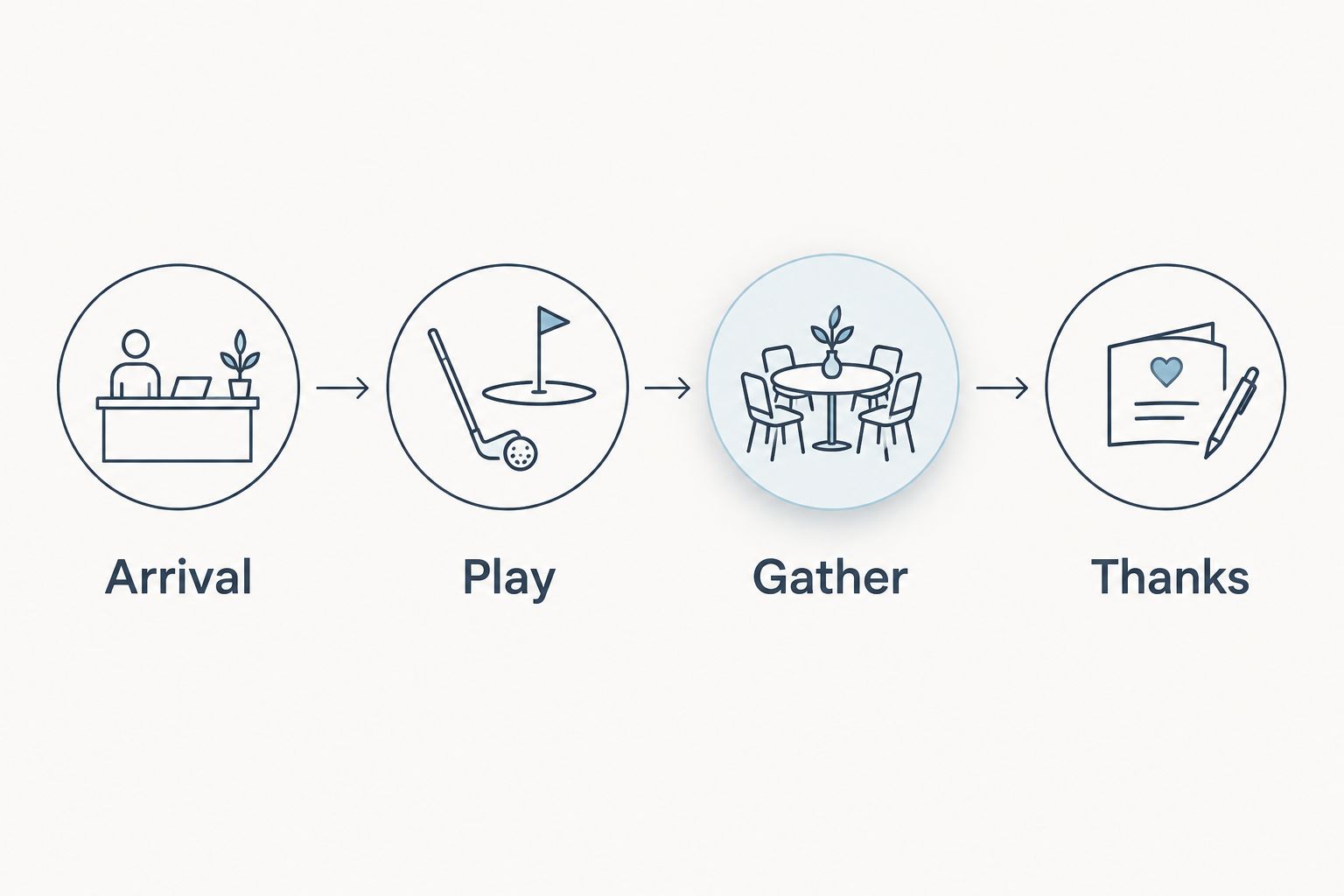
Keep the mission message brief and specific. Tell guests what their support enables, then leave room for conversation. Avoid an awards program so crowded that donors leave before hearing the purpose of the event.
- Assign a check-in lead and a course liaison.
- Give volunteers the same guest instructions.
- Confirm how dietary and accessibility requests reach the right person.
- Name the person responsible for results and announcements.
- Prepare a clear departure and follow-up message.
Prepare registration and contingency documents
Start with a simple form and a shared tracking sheet. Collect only information you need to run the event, communicate with attendees, and honor their choices about future contact. Keep player information, sponsor commitments, and financial records organized rather than spreading them across personal inboxes.
Prepare 3 working documents: a registration list, a volunteer run sheet, and a contingency plan. They do not need elaborate design. They need clear owners, current information, and instructions that another volunteer can follow.
The contingency plan should follow the venue's confirmed terms. Your committee must know who decides on changes, who contacts attendees, and what the nonprofit has promised registrants. Treat emergency response information as a required planning question, not an assumption about course staff.
- Collect names, team assignments, and necessary guest requests.
- State registration inclusions without implying unconfirmed services.
- Keep payment status visible to the responsible organizer.
- Identify the decision-maker for weather-related changes.
- Prepare consistent messages for attendees, volunteers, and sponsors.
Measure the result and complete the follow-up
Close the financial record before describing the fundraiser as a success. Reconcile receipts and expenses, check unfulfilled sponsor commitments, and distinguish event income from net proceeds. Record donated goods separately from cash so the result remains understandable.
For your 2026 review, examine staff and volunteer workload alongside the financial result. An event that depends on undocumented work is difficult to repeat. Ask which tasks served donors and which created avoidable complexity.
Send thanks that connect participation to the cause. Obtain permission before using identifiable guest photographs or sharing personal stories. A follow-up message should make continued involvement clear without treating every attendee as an automatic future solicitation.
- Reconcile registrations, sponsorships, donations, and expenses.
- Complete any outstanding sponsor recognition.
- Thank volunteers and venue contacts for their specific contributions.
- Ask attendees what helped or hindered their experience.
- Save decisions and revisions for the next event lead.
Compare venue and format options
Best for your nonprofit means best aligned with your donors and delivery capacity. Use this comparison to decide what to investigate, then obtain venue-specific terms. Course length alone does not establish event duration, group capacity, or fundraising results.
| Option | Best for | Useful feature | Key limitation |
|---|---|---|---|
| Public nine-hole golf venue | Mixed-experience groups considering a shorter playing format | A nine-hole structure around which to plan the gathering | Group access and interaction with public play need confirmation |
| Eighteen-hole golf venue | Golf-focused supporters who want a full-round event | More holes for a golf-centered program | Requires a schedule suited to the longer playing format |
| Golf venue with clubhouse dining | Groups that want players and non-players to gather together | Golf and dining can be considered in one venue search | Group dining arrangements are separate from the existence of a restaurant |
| Disc golf venue | Supporters who specifically want a disc golf fundraiser | A distinct playing option rather than traditional golf | Do not assume golf tournament arrangements apply to disc golf |
Boulder Creek Golf Club offers public nine-hole golf, clubhouse dining, and disc golf. Its fit is the combination of those activities in a Santa Cruz Mountains setting; its planning limitation is that those offerings do not, by themselves, confirm tournament arrangements. Ask about your intended event before presenting the venue to donors as booked.
Common mistakes nonprofit organizers make
Promising sponsor benefits before venue approval
A sponsor commitment becomes your nonprofit's responsibility even when a volunteer made the promise. Confirm course-dependent benefits before accepting the agreement, and retain a written record of what each sponsor will receive.
Designing only for experienced golfers
A donor event is not automatically a field of confident players. Explain the format, ask about experience, and give non-playing supporters a clear reason to attend. Do not leave beginners dependent on finding a helpful teammate at check-in.
Treating registrations as money raised
Attendance and fundraising are different measures. Review net proceeds alongside participation, and do not announce a final fundraising result while invoices or sponsor payments remain unresolved.
Assuming clubhouse dining means group dining is arranged
A restaurant offering does not establish seating arrangements, a group menu, or an event schedule. Confirm the proposed gathering directly, including how non-playing guests and dietary requests will be handled.
Leaving donor follow-up until after the event
By the time the course is cleared, your volunteers are ready to finish. Prepare acknowledgments, contact preferences, and follow-up responsibilities before the event so thanking supporters does not become an unfinished project.
FAQ
What's the best golf tournament fundraiser venue for a nonprofit?
The best venue matches your donors' playing experience, your event format, and your nonprofit's delivery capacity. Compare confirmed course access, dining arrangements, accessibility, and weather terms before choosing.
Is a nine-hole fundraiser better than an eighteen-hole tournament?
A nine-hole fundraiser is better when your supporters want a shorter playing format; an eighteen-hole tournament suits groups seeking a full round. Confirm the actual schedule with the venue rather than assuming course length guarantees a particular event duration.
Can beginners play in a charity golf tournament?
Beginners can participate when the format and instructions support them. A team scramble lets players contribute together, but organizers still need clear rules, equipment guidance, and course-approved pace expectations.
Can non-golfers attend a nonprofit golf fundraiser?
Non-golfers can attend if your event plan includes a defined role or gathering for them. Confirm dining and gathering arrangements before offering a non-playing registration option.
Does Boulder Creek Golf Club offer nonprofit tournament packages?
Confirm nonprofit tournament arrangements directly with Boulder Creek Golf Club. The club's stated offerings are public nine-hole golf, disc golf, and clubhouse dining; those facts do not establish an event package.
What should we ask a golf venue before booking a fundraiser?
Ask about group access, permitted formats, dining, accessibility, weather terms, and the responsibilities of course staff and your volunteers. Request the agreed arrangements in writing before opening registration.
How do we measure whether a golf fundraiser succeeded?
Measure net proceeds, completed sponsor commitments, donor participation, and the workload required to deliver the event. Keep registrations and gross receipts separate from the money remaining for your cause.
One last thing
Before publishing your 2026 registration page, have someone who is not on the committee read it. Ask them to explain what happens if they do not play golf, what their registration includes, and whom they contact with a question. If they cannot answer, fix the instructions before adding another tournament feature.
The most useful improvement is often a clearer invitation, not a more elaborate event. Give supporters a straightforward way to participate and a concrete reason their participation matters.